
What 11,000 satellites mean for your home connection
You order on Starlink.com at its normal price. First-time customers can currently get a $100 credit there, set by Starlink.
If you're weighing Starlink for a house, the satellite count sounds like the main selling point. Eleven thousand of anything is impressive. What matters at your address is narrower: how steady the connection is, how fast it feels in the evening, and what could go wrong between your roof and the wider internet.
This page translates the constellation numbers, dated November 2026, into those home questions. It also says plainly what more satellites can't fix.
The numbers, dated
The constellation behind a home dish
- 11,195Starlink satellites in orbit on Nov 26, 2026, per Jonathan McDowell's tracker
- About 25 msthe typical delay Starlink cites for low orbit, against 600 ms or more for older satellite service
- 13.6 millionStarlink consumer subscribers on Sept 30, 2026, per SpaceX's third-quarter report as covered by Fierce Network
- 99.7%of U.S. homes and businesses at which Starlink reported service to the FCC as of June 30, 2026
Reporting service at an address isn't the same as having room to add a customer there. Starlink's order page checks your address and has the final say.
Why more satellites help a house
A satellite can only serve so many homes at once. More satellites overhead means more capacity for the same stretch of sky, which is what keeps a street full of video calls and streaming from grinding to a halt.
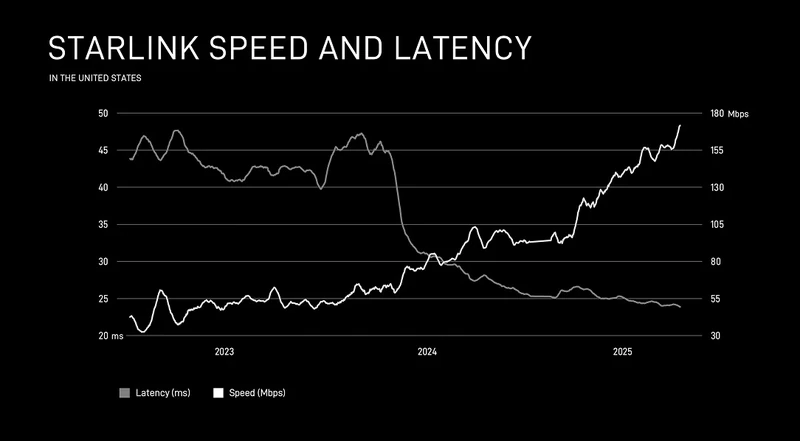
Starlink's own chart of U.S. results shows the direction. Between 2023 and mid-2025, median delay slid from the 40s of milliseconds into the mid-20s while median speed climbed from roughly 50 Mbps to about 170 Mbps. That's a reading of Starlink's chart, so treat the exact figures as approximate, and remember they describe the median customer, not a promise for yours.
- Faster in practice: Starlink reported nearly 200 Mbps median download at peak hours across more than 2 million U.S. customers as of July 2025.
- Still not guaranteed: Starlink says speeds are maximums and can slow when the network is busy.
How your data reaches the internet
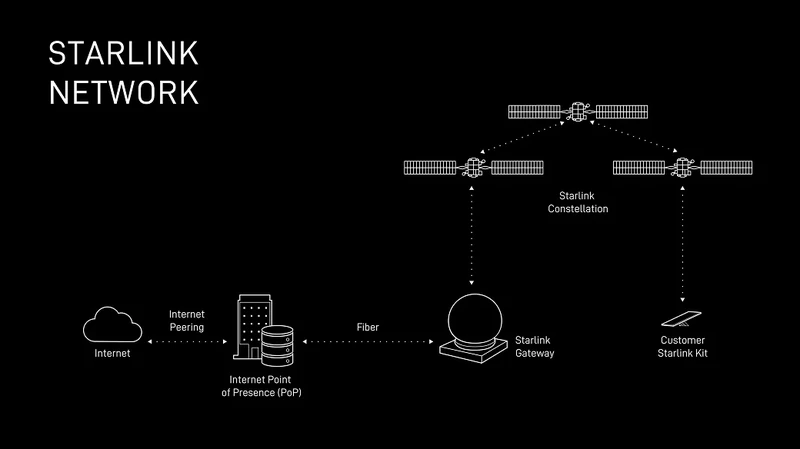
Your dish talks to a satellite overhead. The satellite hands the traffic to a ground gateway, either directly or by way of other satellites, and the gateway connects by fiber to an internet hub. Replies come back the same way.
Starlink says it runs more than 100 gateway sites in the United States with over 1,500 antennas, placed to keep delays low, and that its satellites link to one another by laser so traffic isn't tied to one gateway. For a home, the practical point is simple: the weak spots are rarely the satellites themselves.
What the constellation can't fix at your address
A bigger constellation does nothing for the part of the trip that happens on your property. These are the usual causes of a bad connection, and none of them is a satellite problem:
- Obstructions. A tree, chimney or neighbor's roofline in the dish's view causes dropouts. Starlink's app checks the view before you commit. Our home setup guide covers mounting.
- Power. No power at your house means no dish, no router and no internet, whatever flies overhead.
- Your own network. An old router or weak Wi-Fi in the far bedroom can look like a slow Starlink. Our work from home guide covers the setup that holds up on calls.
- Busy hours. Capacity grows, but evenings in a crowded cell can still run slower than mid-morning.
Starlink's photos of the hardware overhead
These are Starlink's own images. They show what a rooftop dish is working with.

Starlink's artwork of laser links across the sky. Image: Starlink. 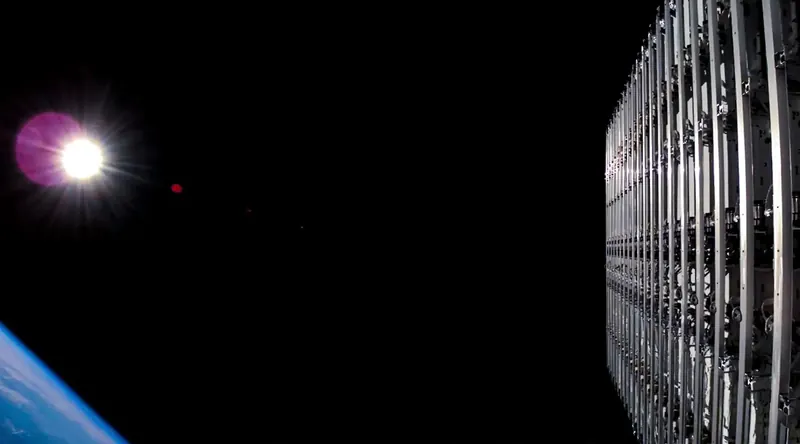
A stack of satellites in orbit before release. Image: Starlink. 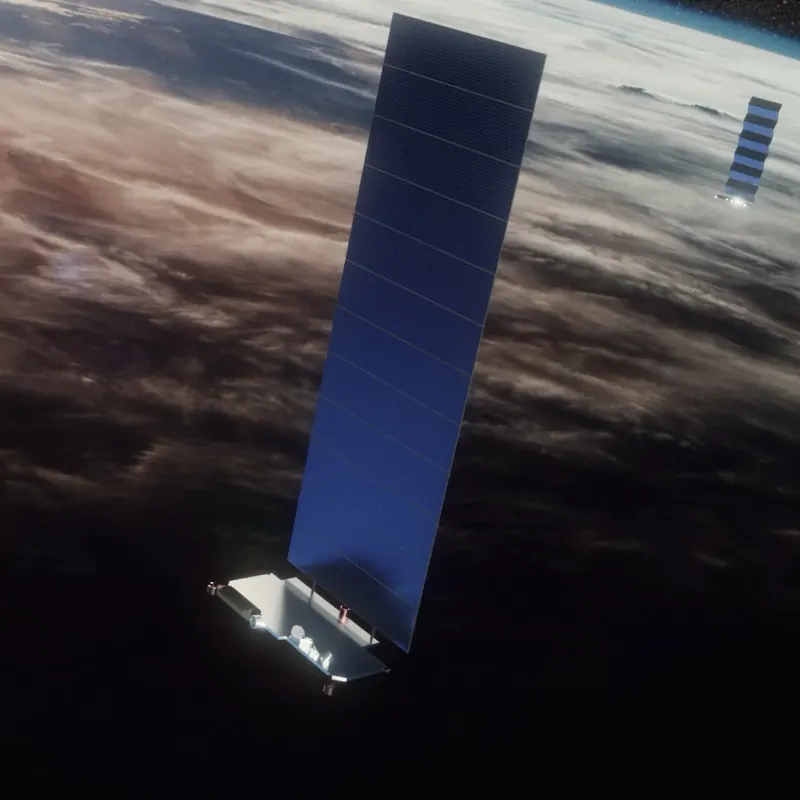
A satellite's solar array against Earth. Image: Starlink.
Your address decides
Check what your address can get
Starlink's order page shows the plans, speeds and hardware price for your exact address, and it flags if your area is limited.
Click to get your $100 credit (Starlink.com, new tab)
How the credit works: Starlink rewards first-time Residential or Roam customers who use this link once they've stayed subscribed for two months. In the U.S. it's $100 today, paid as a bill credit or cash, on terms Starlink controls.
Constellation news, translated for a household
| What's happening | What it could mean at home | How soon |
|---|---|---|
| More satellites in orbit | More capacity per area, which helps in busy cells. | Gradual |
| Larger V3 satellites | Starlink designs every V3 satellite for about 1 Tbps of downlink, roughly 10 times a V2 satellite, which could mean faster busy-hour speeds. | Just starting: the first 26 were deployed in late Sept 2026 |
| Six 400 Gbps lasers on V3 | Faster links between satellites, which helps keep traffic flowing around trouble spots. | Just starting |
| Next-generation gateways | More ground capacity. The FCC approved 36 new gateway sites in November 2026, with 40 antennas per site. | Rolling out |
| Retiring older satellites | A steady swap of old for new, which keeps the count flat but the fleet newer. | Ongoing |
Sources: Starlink's V3 satellite page, Starlink's network update (July 2025) and PCMag's report of the FCC's gateway approvals (Nov 2026). V3 figures are design targets.
Launches: how often, and how fast it changes
The tracker The Space Road counted 87 Starlink launches in 2026 through Nov 25, 85 on Falcon 9 and 2 on Starship. The pace was fastest in spring, with 13 in March, and slower since September, with 4 in September, 4 in October and 1 in November so far.
Starlink says one Starship launch of V3 satellites should add about 20 times the capacity of a Falcon 9 launch of the V2 satellites. That's a design goal, and Starship has only just begun flying them. A launch also doesn't help your house the next day, because new satellites take weeks to climb to working height.
So what should a household do with all this? Judge Starlink by what it delivers at your address, which the 30-day trial and your own speed tests will show better than any satellite count. See Starlink for renters and HOAs if you don't own the roof, and Starlink for a manufactured home if that's your setup.
See your address's plans and price
Starlink's order page checks availability at your address first, and the 30-day trial lets you test the real thing.
Click to get your $100 credit (Starlink.com, new tab)
How the credit works: Starlink rewards first-time Residential or Roam customers who use this link once they've stayed subscribed for two months. In the U.S. it's $100 today, paid as a bill credit or cash, on terms Starlink controls.
Constellation questions from households
How many Starlink satellites are there?
As of Nov 26, 2026, Jonathan McDowell's tracker lists 11,195 in orbit and 11,181 working, out of 13,122 launched since 2019.
Do more satellites make my internet faster?
More satellites add capacity, which can help in busy areas. Starlink doesn't guarantee speeds, and your dish's view of the sky matters at least as much.
Why does Starlink slow down some evenings?
When many customers in one area are online at once, they share the capacity overhead. Starlink says speeds can fall during busy times.
Will the new V3 satellites improve my service?
They're designed to carry far more data, but they only began flying in late September 2026. Expect gradual change, not a switch.
Is Starlink reliable enough for a home office?
Many households use it that way, and the network has plenty of satellites and gateways in view. Add a backup plan for power outages, since the dish needs electricity.
First time with Starlink?
The $100 home credit, briefly
Ordering Starlink for the house for the first time? Begin with the button below and Starlink can credit $100 to your account after two months on a home or Roam plan. Your price at checkout stays the same.
Click to get your $100 credit (Starlink.com, new tab)
The button carries my referral code, which may also earn me a referral benefit. Starlink sets the terms and can change them.